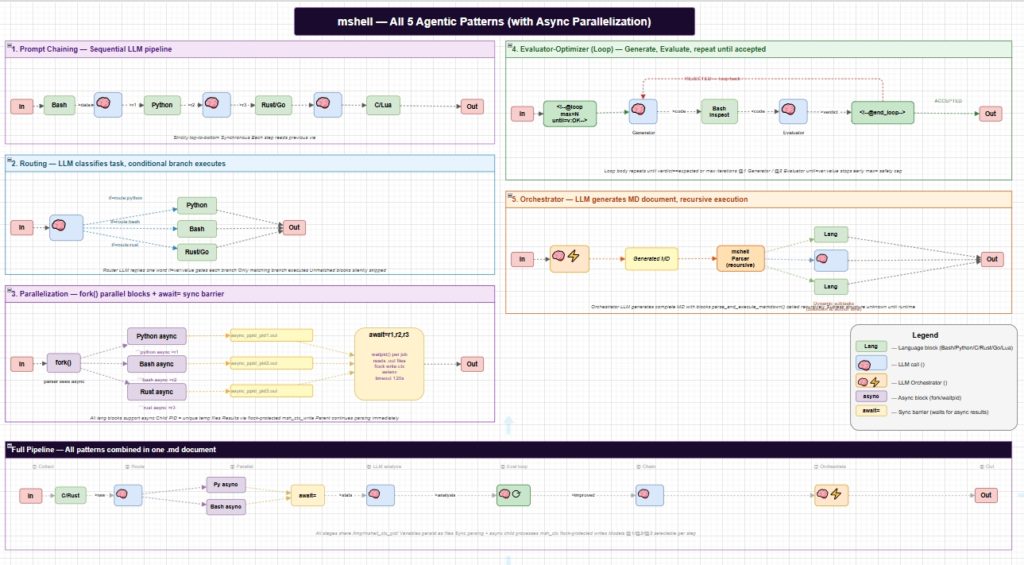

This diagram illustrates the complete implementation of all five canonical agentic workflow patterns in mshell, a polyglot AI-and-mathematics powered shell environment that combines: 7 programming languages (Bash, Python, C, C++, Rust, Go, Lua), 3 LLM vendor backends (Ollama, Claude, OpenAI or connecting throw llm linux evaluation framework), up to 3 different models active simultaneously within a single workflow, direct execution of pre-written code blocks in any supported language, and native mshell commands — all orchestrated from plain Markdown documents.
Pattern 1 — Prompt Chaining shows a sequential pipeline where language blocks and LLM calls alternate, each step consuming the previous output via <var and producing the next via >var. Different models (@1, @2, @3) can be assigned to different steps in the same chain.
Pattern 2 — Routing demonstrates LLM-driven conditional branching: a router model classifies the task and emits a single keyword; the if=var:value fence attribute gates execution so only the matching language branch runs.
Pattern 3 — Parallelization is the newest addition: the async fence attribute triggers a fork(), launching the block in a child process. Results are written to uniquely named temp files (keyed by parent/child PID pair) and collected at an await=var1,var2 barrier via waitpid(). Writes to the shared session context (/tmp/mshell_ctx_<pid>/) are protected by flock().
Pattern 4 — Evaluator-Optimizer implements iterative refinement via <!–@loop max=N until=var:value–> / <!–@end_loop–>. A generator model produces output, an evaluator model scores it, and the loop continues until the verdict matches the expected value or the safety cap is reached.
Pattern 5 — Orchestrator uses <!–@Nx_md–> to have an LLM generate a complete Markdown document at runtime, which is then executed recursively by parse_and_execute_markdown(). The subtask structure is entirely dynamic — unknown at authoring time.
The Full Pipeline at the bottom shows all five patterns composing naturally in a single .md document, sharing session state through the context directory.
Because mshell supports all five patterns natively in plain Markdown — across seven programming languages, multiple LLM vendors and models, executable code blocks, and native shell commands — it serves as a universal agentic execution environment requiring no external orchestration framework and supporting all five canonical agentic workflow patterns.